
|
|
|
|
|
A SOLID FUEL HEATING DICTIONARY These definitions of Solid Fuel terms are provided to help clear confusion in cases of dispute. They are aggregated from usages in various British, Irish and European Standards, with reference to the Oxford English Dictionary. Like any dictionary, this is a record of how words are being used, not how they ought to be used. 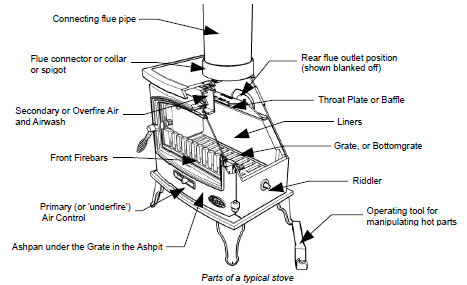 Air Inlet Control: A manual or automatic device to control the quantity of air supplied for combustion Airwash: Secondary air admitted to a glass-fronted fire, usually by way of a slot at the top of the window, so as to be pulled down the inner surface of the window and help prevent staining. Albedo: A measure of the light reflectivity of a surface. Light colours will reflect light (including the infra-red light associated with heat), dark colours will absorb. Anthracite: A hard, compact variety of mineral coal formed at great depth over some 300 million years. It has a high lustre, the highest carbon count and contains the fewest impurities of all coals. Ash: The incombustible residue left when fuels have burned. Essentially all compounds that are not organic or water. Ashpan: A removable receptacle shaped to receive the residue falling from the firebed Ashpit: A chamber designed to receive the residue, usually the space below the grate. Baffle Plate, Throat Plate: A plate fitted above the firebed of an appliance to slow the passage of gasses and so increase efficiency. Basic Firebed: The quantity of glowing embers which ensures ignition of the next fuel charge. Biomass: Solid material derived from plants harvested while recently living, used as a fuel. Boiler Waterway: Space within a boiler which contains water Boiler: Vessel in which water is heated, intended for fitting in or forming an integral part of a solid fuel appliance, whether or not water actually boils, ie reaches 100°C Bottomgrate: Part of the appliance which supports the mass of burning fuel and through which the residue falls into the ashpan or ashpit and through which combustion air and/or combustion gases may be drawn Braai: A type of open fire, usually inset or occasionally freestanding, with a barbecue cooking facility, fitted into a chimney breast either out of doors or indoors as part of a fireplace or kitchen units, common in Botswana, Namibia, South africa and Zimbabwe. Some Braai also have convective heat. Breeze: Powdery coke waste. Builder's Opening: In British and Irish building practice, the opening in a chimney breast at the base of the flue, constructed along with a property. Usually about 1.2m high and wide and 0.5m deep, with a structural lintel above, allowing a variety of fireplaces to be constructed within it. Burning Rate: The reduction in the mass of fuel per unit of time, typically expressed as kg per hour. Caliduct: An old term for a flueway; a passageway through which hot gases are directed in order to usefully dissipate their heat. Carbon Monoxide: a colourless, odourless, highly poisonous gas, CO, formed by the incomplete combustion of carbon or a carbonaceous material, which includes all solid fuels. Carbon Monoxide is slightly lighter than air and very readily combines with haemoglobin in blood, thereby preventing the blood from taking up oxygen. Carbon monoxide poisoning causes dizziness, weakness, pale skin with blue-ish lips and can rapidly be fatal if the victim is not supplied with fresh air. Catalytic Converter: In chemistry, a catalyst is a substance that decreases the amount of energy needed to initiate a chemical reaction without itself being changed at the end of the reaction. Catalytic converters in solid fuel appliances are generally a ceramic mesh doped with heavy metals such as iridium or osmium through which gases from the fire pass and which serves to reduce the temperature at which carbon is converted into carbon monoxide and on into carbon dioxide, resulting in reduced CO emissions. Charging Door: The door which covers the opening through which fresh fuel is added to an appliance. Chimney: The whole structure encasing a flue. 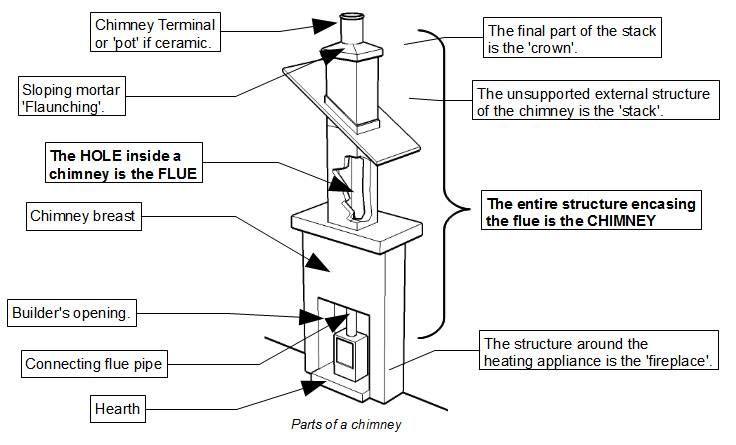 Chimney Heat Gain: The extra heat obtained into the space to be heated from the surfaces of the chimney structure. Chimney Fire: See; Soot Fire Coal: The carbon-laden mineral formed over c50 to 400 million years by the decay of woody material under pressure. The word originally meant any lump of fuel, whether mineral or wood, hence the word 'charcoal'. Coke: The solid residue of impure carbon obtained from bituminous coal and other carbonaceous materials after removal of volatile material by destructive distillation. It is used as a fuel and as a reducing agent in making steel. Combustion Air Selector: A device for adjusting the primary and/or secondary air according to the type of fuel burned Combustion Air: Air supplied to the firebox, which is entirely or partially used to burn the fuel Combustion Control Device: A mechanism for setting the primary and/or secondary air in accordance with the burning rate required Combustion Gases: Compounds in gaseous form produced inside an appliance when fuel is burned Conduction: The transmission of, typically heat or electricity, through a material. Convection: The motion of warm material that rises, cools off, and sinks again, producing a continuous circulation of material and transfer of heat. Enclosed heating appliances transfer heat mainly by convection. Cord: A unit of dry volume used in North America to measure supplied firewood. One cord is commonly 128 ft³ (=c3.6m³), corresponding to a woodpile 8ft wide and 4ft high of 4ft-long logs, though there is some local variation. Curfew: A metal plate used to cover a fire at night. A 16th-18th Century usage. Cf; Fall-Plate DAF: 'Dry ash Free' Damper: A mechanism to change the resistance to flow of the combustion gases. De-Ashing Mechanism: A Riddler, a evice to agitate or disturb the ash to facilitate its removal from the firebed. De-Ashing: The process of clearing a fuelbed and discharging residue into the collecting receptacle Direct Water System: A hot water system in which domestic hot water for taps for washing etc., is heated directly by hot water circulating from a boiler Draught / Draft: The difference in pressure between the inside and outside of a flue which causes a movement of gas inside the flue Draught Regulator: An inlet device for admission air downstream of the firebed, enabling the flue draught to be controlled Draught Stabiliser: A factory-made counter-balanced flap device admitting air to the flue, from the same space as the combustion air, to prevent excessive variations in the draught. It is usual for these to be in the fluepipe or chimney, but they may be located on the appliance. Efficiency: The ratio of total heat output to total heat input, usually expressed as a percentage Energy: The capacity to do work or vigorous activity. Fall-Plate: A hinged plate constructed so as to be able to be moved to cover the fuel, to stop or to restrict combustion. Occasionally used on open fires. See also: Curfew Fire: The rapid release of heat energy and light by the oxidation of fuel. Fireback: The brick or concrete rear part of an open fire. Firebars: The slotted support on which fuel is burned. Firebed, Fuelbed: fuel contained in the firebox Firebox: The chamber in which fuel is burned. Firebox Opening: aperture in the firebox through which the appliance may be fuelled Firebox; Combustion Chamber: That part of the appliance in which fuel is held in order to be burned. Firedoor: The door through which the fire may be viewed and which may be opened to allow refuelling of the firebed Fireplace: The whole of the architectural element enclosing a heating or cooking fire. Fireplace Recess, Or Builder's Opening: A a structural opening in a wall or a chimney breast, from which a chimney leads and which has a hearth at its base. The Recess may form a firebox (as with some open fires) or a separate appliance may be installed inside it. 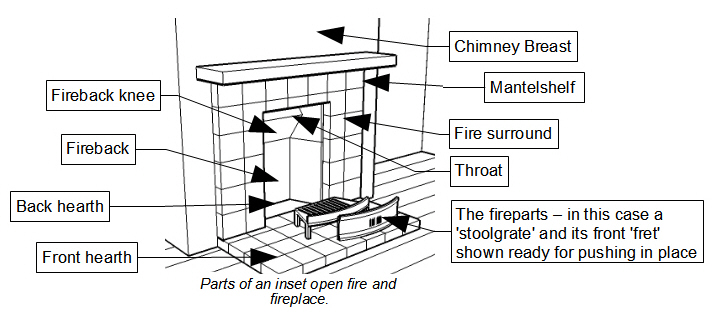 Open Fire Parts According to traditional practice in Britain and Ireland Flaunching: A sloping fillet of masonry or mortar, intended to throw off material falling down on it. A falunching is used to throw off water at the junction where a masonry chimney stack comes through a roof, around a chimney pot etc, and above a fireback where it meets the flue of a chimney gather to divert falling soot into the combustion chamber. Flue: The hole or shaft inside a chimney through which waste gases pass to the atmosphere. Thin metal chimney parts, as they consist mainly of hole are commonly referred to as flue or flue-pipe. Flue Draught: The differential between the static air pressure in the place of installation and the static pressure at the flue gas measurement point Flue Gas Adaptor: A fitting which allows for variations in size and shape of the flue components Flue Gas Connector: A duct through which flue gases are conveyed from the flue spigot of the appliance into the chimney flue. Flue Gas Mass Flow: The mass of flue gas drawn off from the appliance per unit of time Flue Gas Temperature: The temperature of the flue gas at the specified point in the measurement section Flue Gases: The gaseous compounds leaving the appliance flue spigot and entering the flue gas connector Flue Loss Analysis: Method of determining the performance of a heating appliance by determining the temperature and chemical composition of the waste gasses being lost into the flue, from which the efficiency and heat output can be estimated. Flue Spigot; Flue Socket: The integral part of the appliance for connecting the flue gas connector thus permitting the deliberate escape of: products of combustion into the chimney flue Flueway: That part of the appliance designed to convey combustion gases from the firebox to the flue spigot Front Firebars; Deepening Plate: The grating or plate fitted at the front of the firebox opening to prevent spillage of fuel and ash or to change the firebox capacity, or both Fuel Hopper: A fuel store integral with the appliance from which fuel is fed to the firebox Fuel Regulator: A device for controlling the size of the firebed Grate: See Bottomgrate Heat Input: That quantity of energy, which the fuel provides to the appliance Heat Output: That quantity of useful heat released by the appliance Heat: A form of energy associated with the motion of atoms or molecules and capable of being transmitted through solid and fluid media by conduction, through fluid media by convection, and through empty space by radiation. Housecoal: The type of coal normally supplied for domestic use. This will vary from place to place, in Britain and Ireland it is taken to mean bituminous coal, in the USA it usually means anthracite. Indirect Water System: A hot water system in which stored domestic hot water is heated by a primary heater through which hot water from: the boiler is circulated without mixing of the primary (heating) water and the stored domestic hot water Integral Fuel Storage Container: An enclosed area forming part of the appliance, but not connected directly to the fuel charging area, in which fuel is stored prior to it being physically transferred by the user to the fuel charging position Kachelöfen: German type of Masonry Stove Kennel or Cannel: A light, clean, fine-grained bituminous coal. The term may be a corruption of "candle" because it burns without smoke. There are deposits in North America, UK, Poland, South Africa and Australia. Lignite: A soft, brownish fuel material, intermediate between peat and bituminous coal, formed over c4000 years. Mantel: (Note spelling, not 'mantle' (OED)) The structural or ornamental structure around a fireplace opening. Masonry Heater Or Masonry Stove (German= Kachelöfen, Russian= Petche): Type of enclosed roomheater which stores heat in a brick labyrinth. Well-designed masonry stoves may only need firing for an hour or so to provide 24 hours of heating. Maximum Water Operating Pressure: The limiting water pressure up to which the boiler of an appliance can be safely operated Mineral Fuel: See, Solid Mineral Fuel Multi-Fuel or Multifuel: An appliance capable of burning both mineral and wood fuels. Generally, wood-burning appliances cannot burn mineral fuels - burning coals placed on a true wood-burning appliance will be extinguished. But mineral-fuel appliances can usually burn wood, albeit often with poor efficiency and amenity, eg, very high ash production. Multifuel appliances have a firebox which can either be adapted to wood or mineral use, or which provides a compromise between the two. Nominal Heat Output: In official Standards, the total heat output of an appliance quoted by the manufacturer and achieved under defined test conditions when burning the specified test fuel. Operating Tool: A device supplied with the appliance for handling movable, adjustable and/or hot components. A glove is often supplied as a tool for handling hot parts. Peat or Turf: Woody material which has semi decomposed over about 1000 years. The earliest stage in the formation of coal. Petche: Russian Type of Masonry Stove Petcoke, Petroleum Coke: A solid fuel made from petroleum residues. High in sulphur and low in protective ash it burns with intense heat, but can damage appliances and cause high levels of atmospheric sulphuric acid unless used mixed with another material (such as an alkaline stone or coke). Primary Air: That supply of combustion air to the firebed of an appliance which passes through, rather than over, the mass of fuel. Pyrolignins: General term for the organic substances formed when wood partially burns. Pyrolisis: The decomposition of a chemical compound by heat. The chemical decomposition of organic materials by heating in the absence of oxygen or other reagents. 'Complete' pyrolysis, leaving only carbon as the residue, is carbonization. Pyrometer: Any high-temperature thermometer, especially optical pyrometers which estimate the temperature of an object too hot to make contact with by analysing the visible and non-visible light emitted. Radiation: The emission and transmission of energy through space or through a material medium, or the radiated energy itself. Heat radiation travels in straight lines, requires no medium (it can travel through a vacuum) and diminishes by the square of the distance travelled. Recommended Fuel: In official Standards, that fuel of commercial quality listed in the appliance manufacturer's instructions, and shown to achieve the claimed performance when tested in accordance with a Standard. Recovery Capability: The ability of the fire to re-ignite existing or newly charged fuel after a defined burning period without external assistance. Refuelling Interval: Period of time for which the combustion may be maintained in the appliance with a single load of fuel, without intervention by the user Residue: Ashes, including combustibles, which collect in the ashpit Rice Coal: Small (c 5 to 8mm) anthracite, used in specialised automatic-feed appliances. Riddler, Riddling Mechanism: See; De-ashing mechanism Roomheater: The preferred term for 'stove' in British Standards. Sea Coal: Traditionally, that coal which is found washed-up on shore from undersea seams. The term is sometimes used for bituminous coal in general. Seasoned Wood: Wood with less then 20% moisture content, prepared for burning. Secondary Air: That air supplied for the purpose of completing the combustion of gases leaving the fuel bed. Slack: Powdery waste coal. Slow Combustion Heat Output: The heat output achieved during the test period under slow combustion conditions Slow-Combustion Capability: The ability of an appliance to continue operating at a low burning rate for a specified minimum period without any: input of fuel and without any interference with the combustion process, in such a manner that the firebed can be: recovered at the end of this period Smoke: Solid particles suspended in gas. Smoke Shelf: A ledge formed inside the lower part of a chimney serving an open fire in the erroneous belief that this could improve draught. Solid Fuel: Solid material used as a fuel, a natural or manufactured solid mineral fuel, a natural or manufactured wood or peat product. The term is sometimes used as a signifier for 'mineral fuel'. Soot: Black, dry, powdery deposits, near pure carbon. Formed when fuels do not burn completely. Soot Fire: (or Chimney Fire) Condition where soot deposits inside an appliance but outside the normal combustion zone, or inside the chimney ignite. This condition can generate very dangerously high temperatures. Solid Mineral Fuel: Any solid fuel derived from mineral, not plant, material. Fuels such as coal, lignite, coke and other fuels derived from these. Space-Heating Output: Heat output provided by convection and radiation to the room Stack, Chimney Stack: The freestanding part of a chimney above the building it serves. Start-Up Device: A mechanism to divert the path of the heating gases and/or change the combustion air opening cross section during: the ignition period. Steady-State Condition: The stage at which values to be measured in successive equal periods of time do not exhibit significant change. Stoolgrate: A bottomgrate, self-supporting on small integral legs. Stove: An appliance which heats one space, either the individual room-space it is in (as with heating stoves), or just its own space (as with a cooking stove). Central-heating devices, whether boilers or hot-air heaters, are not 'stoves' in that they heat not one but many spaces, yet they also emit heat into the space they themselves are in and are therefore more accurately described as 'stoves with central heating'. The Old English stofa meant any individual enclosed space, such as a room, and is still occasionally used in that sense, as in 'stoved in'. Until well into the 19th Century 'stove' was used to mean a single heated room, so that the naturalist Joseph Banks' assertion that he 'placed his most precious plants in the stove' or Rene Descartes observation that he got 'his greatest philosophical inspiration while sitting inside a stove' are not as odd as they seem. Test Fuel: In EN Standards, a fuel of commercial quality being characteristic of its type to be used for testing. appliances Thermostat: A device which automatically responds to variation in temperature. In solid fuel appliances this is commonly a device which responds to the temperature of air (or of water in a wet heating system) to adjust the combustion air inlet cross-sectional area. Throat Plate: An alternative name for Baffle Plate. Total Heat Output: In the usage of EN standards, "The rate of useful heat released by an appliance", in which usage it does not include Chimney Heat Gain. Turf: An alternative name for Peat fuel. Type Test Pressure: The pressure at which parts have been tested. This is not necessarily the recommended operating pressure. Water-Heating Output: Heat output to water averaged during the test period Wood Powder: The white-ish flocculent powder left when wood has disintegrated while burning. Wood Powder is not ash, and, if kept hot enough for long enough can be made to burn. True wood ash is brown-ish and relatively dense, sand-like. High outputs of Wood Powder indicate a poorly-designed or poorly-operated fire. Working Surfaces: All the surfaces of an appliance designed to transmit heat to the surrounding atmosphere. All external surfaces of a heating appliance, including the flue gas connector, are, in EN standards, classified as working surfaces. |
|
MORE FROM Soliftec... Home ● Fuel Costs ● Installation ● Library ● About ● Air Supply ● Blogspot ● Building Rules ● Carbon Monoxide ● CE Marking ● Dictionary ● Efficiency ● Electricity - CHP ● Embodied Energy ● Fascinating Facts ● Fireplace Doctor ● Fuel Properties ● Heat Need ● Heroes ● Legislation ● Manufacturers ● Open Fires ● Smoke ● Solid Fuels ● Standards ● Statistics ● Stove History ● Tables, Data and Formulas ● Test Laboratories ● Thatched Roofs ● The Carbon Cycle ● The Chimney Effect ● Wood Fuel ● Email: info@soliftec.com COPYRIGHT and ALL RIGHTS RESERVED: © Soliftec Ltd, Thursday 19 December 2019 BUILT WITH WHIMBERRY matrixstats |